
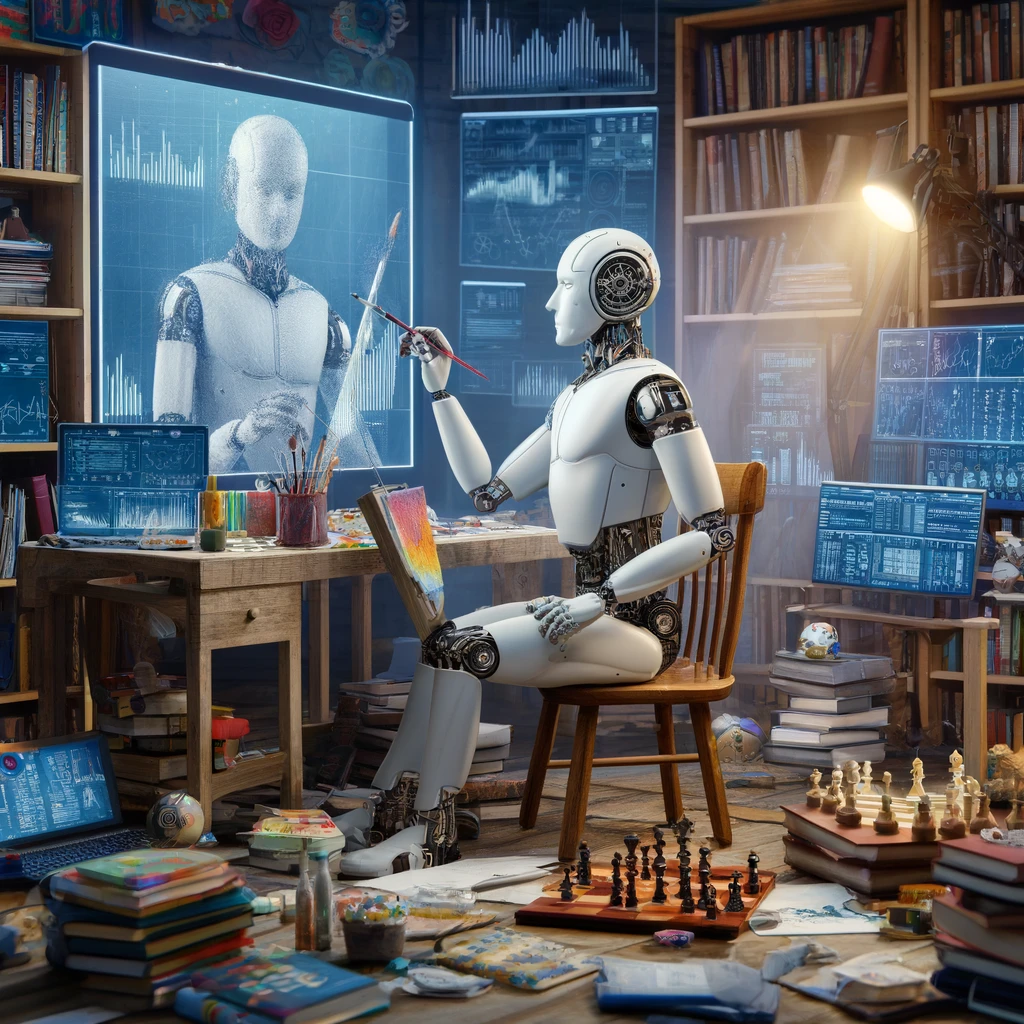
AI’s capabilities in creative and strategic thinking are limited by its reliance on existing data and lack of emotion. AI can generate informative content by identifying patterns in data, but it lacks the human capacity for intention-driven creativity. AI often produces work that may lack emotional qualities or reasoning. AI typically performs well in structured scenarios but cannot easily navigate the simplicity of human strategic thinking. While AI is useful as a tool for certain tasks, it cannot fully replace human creativity and strategic insight.
In the fields of art and architecture the limitations of AI are evident. AI can assist designers and artists by providing new ways to visualize concepts and analyze structural efficiencies, though lacks the creative intuition and emotional connection that human artists and architects bring to their work. In the field of architecture, the designing of spaces that evoke specific feelings or fulfill complex social and cultural functions cannot be fully captured by AI algorithms. The absence of a deeper understanding of human experiences and cultural contexts in AI can lead to designs and artwork that may lack the soul and resonance that human-made creations inherently possess. AI’s computational power and data processing capabilities can augment human creativity and act as a tool, rather than replacing it.
Citations:
OpenAI. (2024). ChatGPT (4) [Large language model]. https://chat.openai.com
Prompts:
“Proof these two paragraphs”