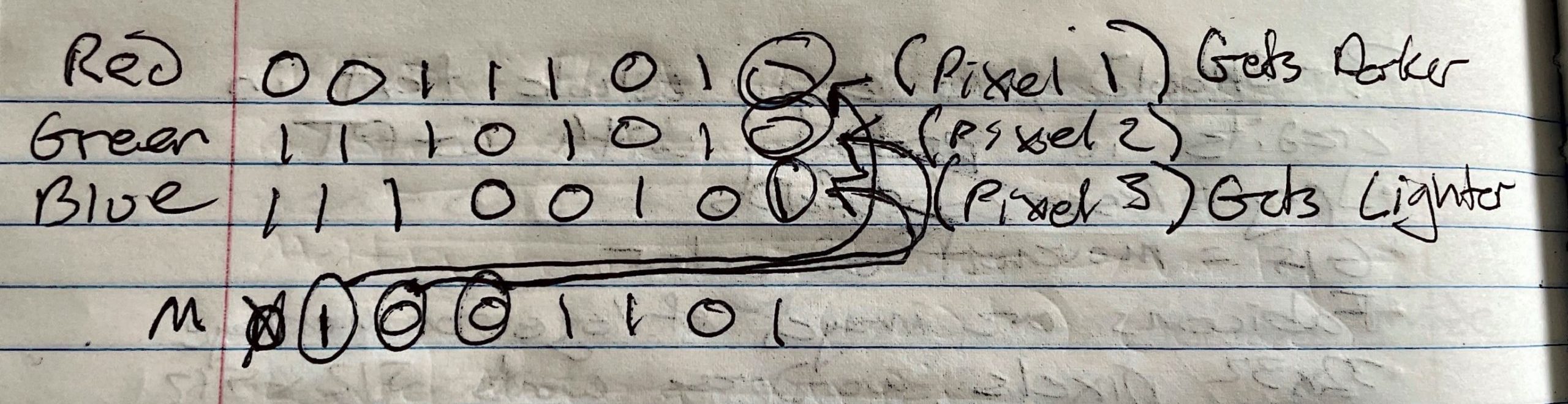

Steganography conceals information within images by subtly embedding text so that it remains nearly undetectable to those unfamiliar with the technology. The process specifically involves altering the first few pixels of an image, slightly adjusting the colors of certain pixels in a manner corresponding to binary code. By modifying the least significant bit to match the ASCII numerical code, secret text can be encoded within an image. This technique is primarily employed for secure communication and digital watermarking to protect copyrights. Its main goal is to transmit information securely by camouflaging it in plain sight, thus evading unauthorized detection. However, the potential misuse of such technology by terrorist groups for undetected communication highlights its dual-edged nature.
Citations:
OpenAI. (2024). ChatGPT (4) [Large language model]. https://chat.openai.com
Prompts:
“Correct grammar and proof following paragraph”
“How does steganography work?”
- Least Significant Bit (LSB) Insertion: This is a common method where the least significant bit of some or all of the pixels in an image is altered to include the bits of the hidden message. Since the change is minimal, it is usually not perceptible to the human eye.
- Masking and Filtering: These techniques are more sophisticated and modify the image in a way similar to how watermarking changes a picture. They are typically used with more significant parts of an image, making them more robust to compression and transformation.
(20% GPT, 80% Notes)